For years, the digital sales room (DSR) was little more than a glorified file-sharing folder, a branded landing page where sellers dumped PDFs, case studies, and pricing sheets, then waited to see if a buyer clicked anything. That model is now outdated. In 2026, the winning DSR platforms are AI-native, meaning artificial intelligence isn’t a bolt-on chatbot but the underlying infrastructure that powers how content is delivered, how buyer questions get answered, and how deals get forecasted.
An AI-native digital sales room is a secure, collaborative online workspace where B2B buyers and sellers interact, but with intelligence woven into every layer of the experience. Instead of passively tracking link clicks, the room actively participates in the sale, answering buyer questions in real time, summarizing meetings automatically, and managing follow-ups even when the sales rep is offline or asleep. It behaves less like a document repository and more like a tireless, always-on member of the deal team.
Below, we break down the core pillars that define this new category, profile the platforms leading it in 2026 with their features, G2 ratings, and quick takeaways, and compare how the buyer experience has fundamentally changed.
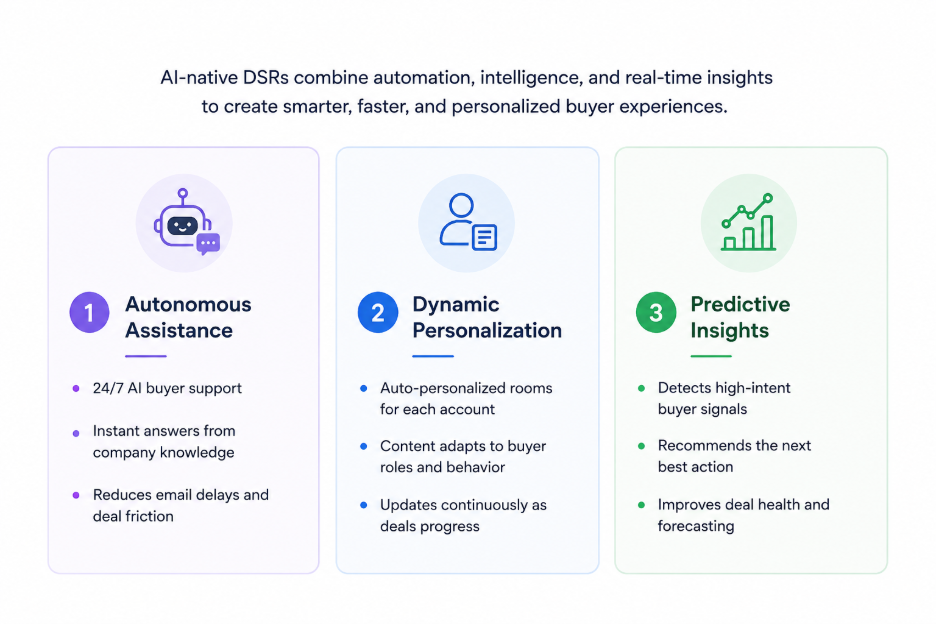
Core Pillars of AI-Native DSRs
1. Autonomous Assistance
At the heart of every AI-native room is an AI agent that functions as a 24/7 co-pilot. Rather than forcing buyers to email the rep and wait for a response, this agent draws directly from the company’s knowledge base, product documentation, past RFP answers, security questionnaires, and pricing logic, to answer questions the moment they’re asked.
A procurement lead reviewing a security addendum at 11 p.m. no longer wait until business hours; the room itself can walk them through compliance certifications, data residency policies, or integration requirements instantly. This autonomous layer doesn’t replace the seller, but it removes the friction of asynchronous, drawn-out email threads that so often stall deals in the evaluation stage.
2. Dynamic Personalization
Legacy DSRs required a rep to manually build and rebrand a room for every account, then manually update it as the deal evolved. AI-native rooms automate this entirely. The moment a room is spun up, it can pull the buyer’s logo, brand colors, and relevant stakeholder names automatically.
As the deal progresses, the room restructures itself based on real engagement data and live CRM signals, surfacing the ROI calculator when a CFO joins, promoting a technical integration guide when an engineering stakeholder logs in, or reordering content based on what previous similar accounts responded to. Personalization stops being a one-time setup task and becomes a continuous, automated process.
3. Predictive Insights
Perhaps the most transformative pillar is predictive intelligence. AI-native rooms don’t just log that a buyer viewed a pricing page, they interpret what that behavior means. High-intent signals, such as a legal stakeholder opening a contract redline tool or multiple new logins from a single domain within 24 hours, automatically trigger next-step recommendations for the rep: send the security one-pager now, or loop in a solutions engineer since the technical buyer is engaging with the API docs.
These same signals feed directly into CRM forecast categories, giving sales leadership a far more accurate, real-time view of deal health than static, rep-reported forecasts ever could.
Top AI-Native DSR Platforms in 2026
The category has matured quickly, and a handful of platforms have emerged as the clear leaders. Each takes a slightly different approach to embedding AI into the sales room experience. G2 ratings below are current as of mid-2026 and will naturally shift as new reviews come in.
1. Dock
G2 Rating: 4.7 / 5
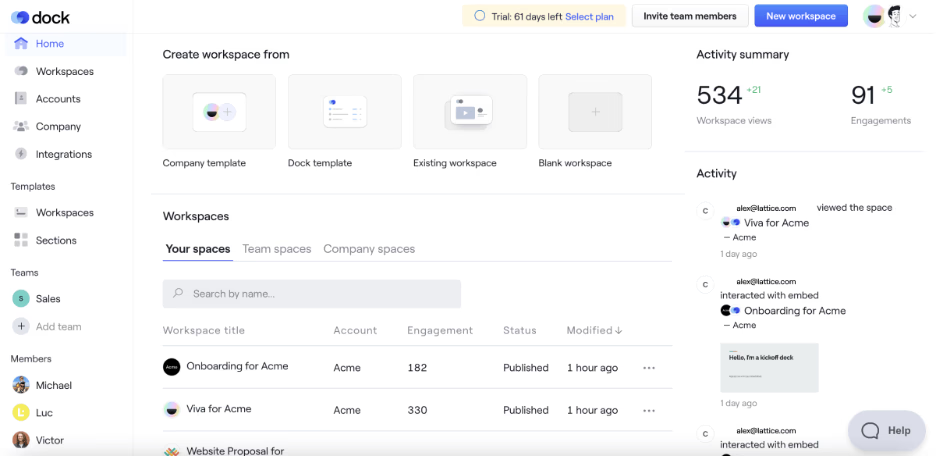
Dock has positioned itself as a full-lifecycle revenue enablement platform rather than a standalone DSR tool. It connects AI-powered digital sales rooms with internal content libraries, customer onboarding workspaces, and bidirectional CRM syncing, so data flows both ways between the room and systems like Salesforce or HubSpot in real time.
Features:
- AI-powered digital sales rooms tied to internal content libraries
- Bidirectional, real-time CRM syncing (Salesforce, HubSpot)
- Mutual action plans shared between buyer and seller
- Customer onboarding workspaces that carry deal context forward
- Engagement analytics on individual buying-committee members
2. Projetly
G2 Rating: 4.8 / 5
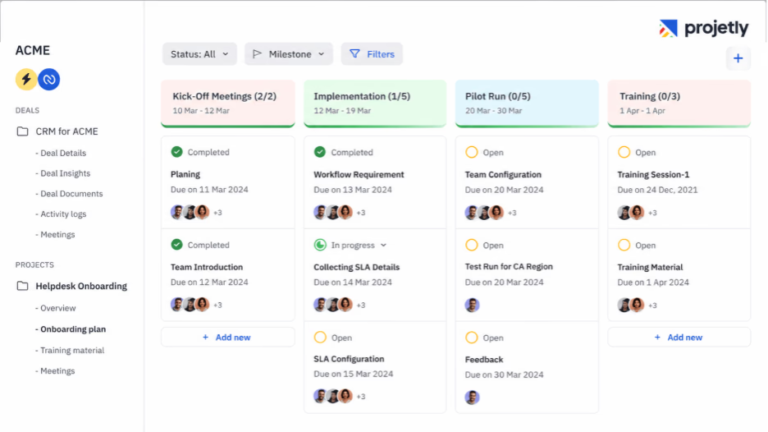
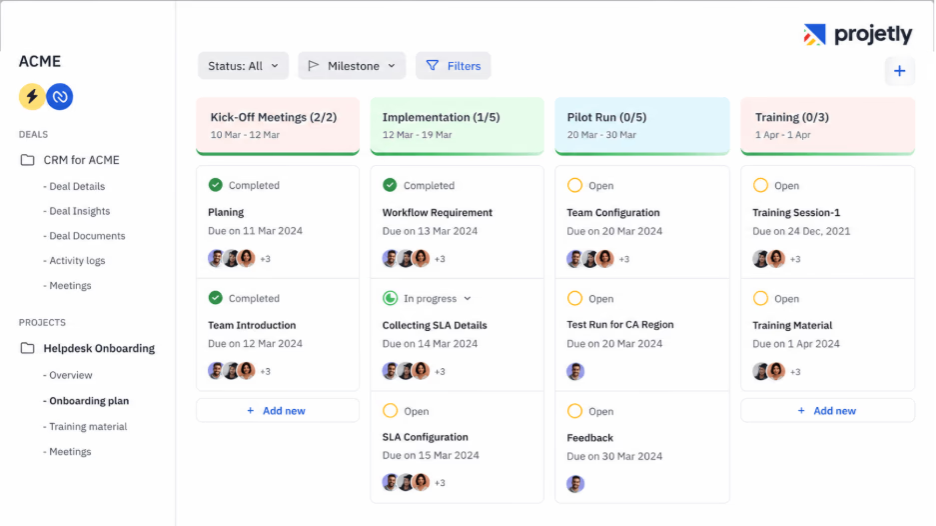
Projetly is an AI-native digital sales room built specifically to close the gap between sales and onboarding, so deals don’t just close, they go live. It’s aimed at B2B teams with complex, multi-stakeholder sales cycles and longer implementations, giving reps a single AI-powered workspace for every deal.
Features:
- AI Deal Copilot for next-best-action suggestions and in-room buyer Q&A
- Buying committee map with persona confidence scores and risk flags
- Buyer engagement tracking across documents, email, and meetings
- Magic Link buyer portal with no login friction
- Automatic context transfer from the deal room into the onboarding project at closed-won
- AI meeting notes with automatic action item extraction
3. Mindtickle
G2 Rating: 4.7 / 5
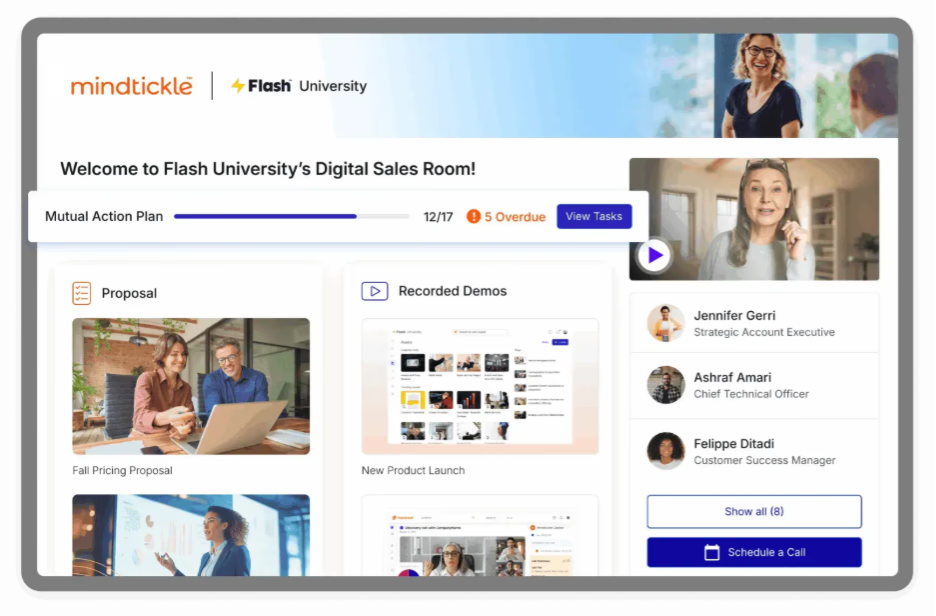
Mindtickle takes a different angle, embedding its digital sales room capability inside a broader agentic enablement platform powered by what it calls ElevateOS. Rather than treating the DSR as an isolated tool, Mindtickle maps buyer engagement data captured in the room directly back to individual sales rep skill gaps and coaching plans.
Features:
- Digital sales rooms built as custom buying rooms for every opportunity
- ElevateOS layer connecting room engagement data to rep coaching and forecasting
- Sales training, reinforcement, and AI-powered role-play tools
- Readiness Index benchmarking against an Ideal Rep Profile
- Deep integration between content management and live deal execution
4. Along
G2 Rating: 4.9 / 5
Along’s flagship feature is “Along Brain,” an AI deal co-pilot embedded directly into its portal experience. Along Brain continuously analyzes buyer behavior inside the room and surfaces insights the rep might otherwise miss, while also helping build and optimize mutual action plans.
Features:
- Along Brain AI co-pilot for next-best-action recommendations
- Mutual action plans (MAPs) with shared deadlines and accountability
- Real-time buyer engagement notifications (email, Slack, in-app, CRM)
- Native integrations with Salesforce, HubSpot, Pipedrive, and Zapier
- GDPR, SOC 2, and ISO 27001 compliant, with data hosted in Germany
5. Trumpet
G2 Rating: 4.8 / 5
Trumpet has doubled down on auto-personalization and auto-branding as its core differentiators. Every room it generates adapts its look, structure, and messaging automatically based on the buyer’s company and stakeholders, with minimal manual setup from the rep.
Features:
- Automatic room branding and personalization per buyer account
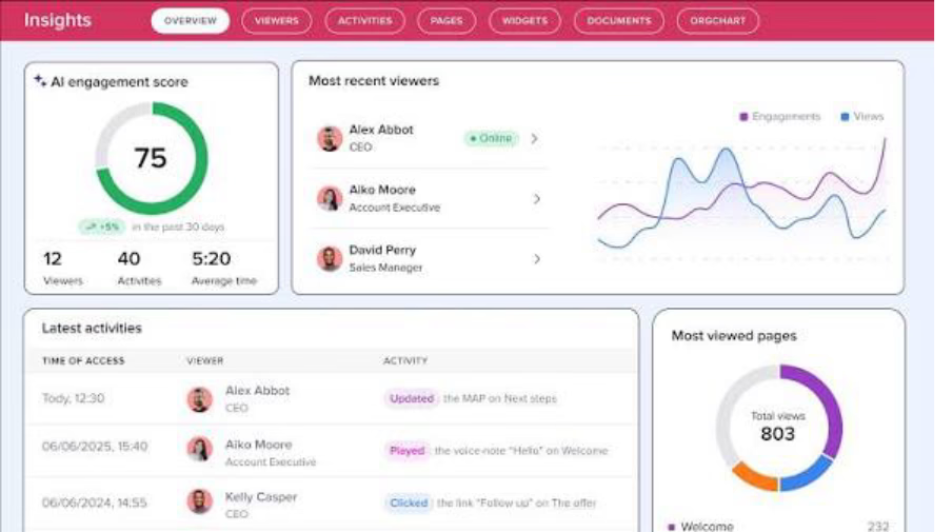
- Buyer intent signal extraction to gauge deal velocity
- 35+ native integrations, including Salesforce, HubSpot, Slack, and Calendly
- Pods, or purpose-built rooms, for pre-sale and post-sale motions
- Engagement analytics showing which content actually drives follow-up
6. Flowla
G2 Rating: 4.9/ 5
Rounding out the list is Flowla, which leans into AI-assisted digital workflows and pre-built templates to guide complex B2B buyer journeys from first touch through handoff and onboarding. It’s particularly well suited to deals involving multiple internal handoffs, since its templated workflows are designed to keep context and momentum intact across each transition.
Features:
- AI-assisted workflow templates for multi-stage buyer journeys
- Structured handoffs between SDR, AE, and customer success roles
- Clean, intuitive buyer-facing interface with minimal setup time
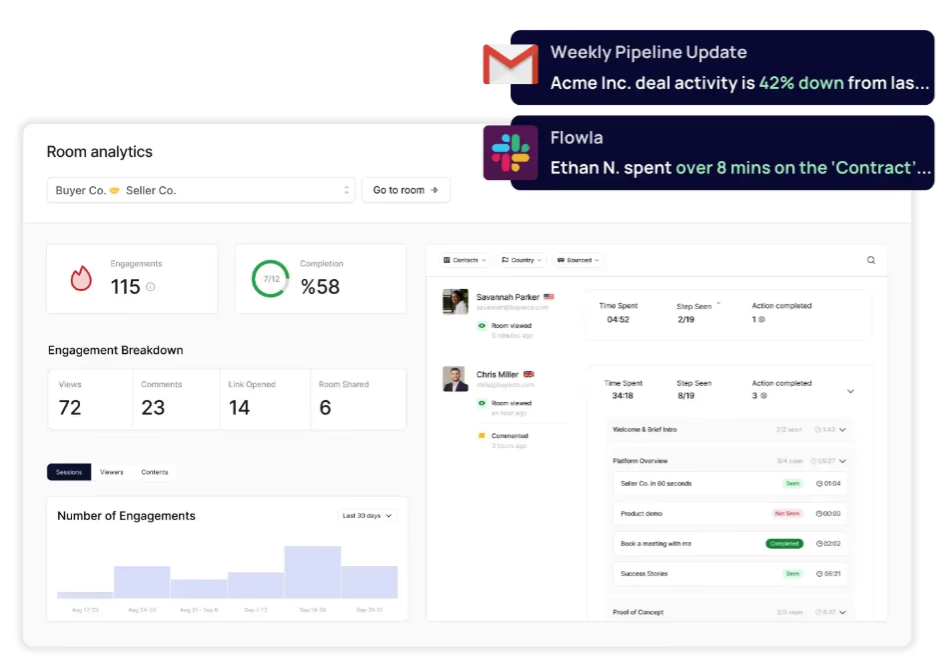
- Engagement tracking tied to each stage of the workflow
- Strong fit for small and mid-market teams moving upmarket
How AI Transforms the Buyer Experience
The shift from legacy to AI-native rooms is best understood by comparing the two side by side across the moments that matter most in a B2B deal.
| Capability | Legacy Digital Sales Room | AI-Native Digital Sales Room |
| Content Delivery | Static folder of PDFs and pitch decks, the same for every buyer | Tailor-made asset recommendations that shift automatically based on deal stage and stakeholder role |
| Buyer Questions | Buyer emails the rep and waits hours, sometimes days, for a reply | AI bot answers technical, RFP, or product questions instantly, any time of day |
| Meeting Sync | Rep manually uploads notes or recording links after the fact, if at all | Auto-captures calls, generates action items, and updates the room without manual effort |
| CRM Integration | Basic, one-way tracking of page views with little context | Bidirectional sync of custom fields, engagement scores, and automations that update the CRM in real time |
The pattern across every row is the same: legacy rooms are passive and reactive, while AI-native rooms are active participants in the deal. That difference compounds over the course of a sales cycle. A buyer who gets an instant, accurate answer to a technical question at 9 p.m. on a Sunday is far more likely to stay engaged than one who must wait until Monday afternoon for a reply. A forecast built on real, granular engagement signals is far more trustworthy than one built on a rep’s gut feeling entered a CRM dropdown.
Frequently Asked Questions
1. What makes a digital sales room “AI-native” instead of just “AI-enabled”?
An AI-native room is built with AI as core infrastructure from day one, powering content selection, buyer Q&A, and forecasting. An AI-enabled room, by contrast, usually bolts a chatbot or a single AI feature onto an otherwise static, manually managed room.
2. Are AI-native digital sales rooms secure enough for sensitive deal information?
Most leading platforms, including the ones covered here, carry certifications such as SOC 2, ISO 27001, or GDPR compliance, and use role-based access controls so only approved stakeholders can view specific content. It’s still worth confirming a vendor’s exact security posture against your company’s own requirements before rolling out sensitive deals.
3. Do AI-native DSRs replace the sales rep?
No. The AI agent handles repetitive, time-sensitive tasks like answering FAQs, summarizing calls, and flagging disengagement, freeing the rep to focus on strategy, negotiation, and relationship building. Reps still own the deal; the room just removes friction around it.
4. How long does it take to set up an AI-native digital sales room?
Most platforms on this list can generate a branded, personalized room within minutes once connected to a CRM, since branding, stakeholder names, and initial content are pulled in automatically. Fuller customization, like custom templates or workflow automation, may take longer depending on team size and use case.
5. Can AI-native DSRs integrate with existing CRM and sales stacks?
Yes. Bidirectional CRM syncing is one of the defining pillars of the category. Platforms such as Dock, Along, and Trumpet integrate with Salesforce, HubSpot, and Pipedrive, among others, so engagement data updates deal records automatically instead of requiring manual entry.
6. Which platform is the best fit for a small or fast-growing sales team versus a large enterprise?
Smaller, fast-moving teams often lean toward Flowla, Trumpet, or Along for their quick setup and lighter learning curve, while larger enterprises with dedicated enablement functions tend to favor Mindtickle or Dock for their deeper coaching and full-lifecycle capabilities. Projetly sits in between, built specifically for mid-size to large B2B teams managing complex, multi-stakeholder deals with long implementations.
The Road Ahead
As we move deeper into 2026, the gap between legacy and AI-native digital sales rooms is only going to widen. Buyers increasingly expect the same instant, personalized experience from B2B vendors that they get from consumer products, and sales teams that still rely on static folders of collateral are going to find themselves losing deals to competitors whose rooms can answer a question, resurface the right asset, and flag a stalled deal automatically. Whether a team chooses Dock for its full-lifecycle reach, Projetly for its sales-to-onboarding continuity, Mindtickle for its coaching integration, Along for its collaborative deal co-pilot, Trumpet for its personalization engine, or Flowla for its workflow templates, the underlying lesson is the same: the digital sales room is no longer a place buyers visit, it’s becoming an active participant in how the deal gets won.