Not every sales team needs the same thing from a digital sales room. A 10-person startup closing $5K deals in a single call has different priorities than an enterprise team running six-month cycles with ten stakeholders and a handoff into onboarding. The right platform depends less on “which one is best” and more on which one matches how you actually sell.
Here are the 7 best digital sales room platforms worth putting on your shortlist in 2026, and the sales motion each one is built for.
1. Projetly: Best for Enterprise Deals That Need to Survive the Handoff to Onboarding
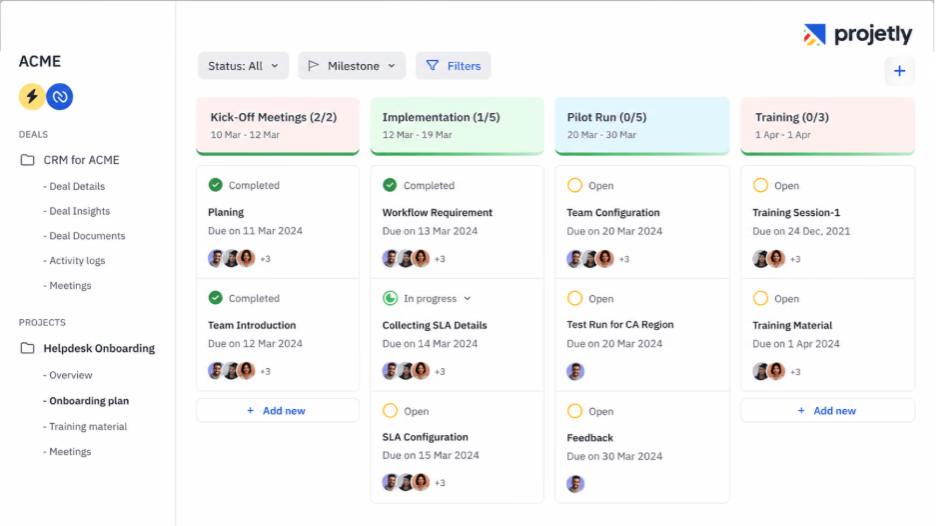
Most digital sales rooms stop working the moment a deal closes. Projetly is built around the opposite idea. The same room that runs the sales cycle carries forward into onboarding, enabling a seamless sales-to-CS handoff. Nothing gets rebuilt, and no context gets lost when a deal moves from the Account Executive to the Customer Success team.
Key features:
- AI-powered digital sales rooms with a branded, centralized workspace
- AI meeting intelligence for call transcription and action items
- Individual-level stakeholder engagement analytics
- Mutual action plans (MAPs) with stakeholder mapping and org charts
- Automatic conversion of won deals into onboarding projects
Best fit for: Enterprise B2B SaaS, fintech, and IT services teams managing complex, multi-stakeholder deals who want AI handling the busy work and a genuinely seamless move from sale to onboarding, not a second workspace to rebuild from scratch.
Worth knowing: As a newer entrant, it’s best suited to teams with real deal complexity. Simple, transactional sales won’t get much out of its deeper features.
Pricing: Custom pricing; visit projetly.ai to explore plans or book a demo.
2. Aligned: Best for AI-Assisted, Buyer-Centric Deal Rooms
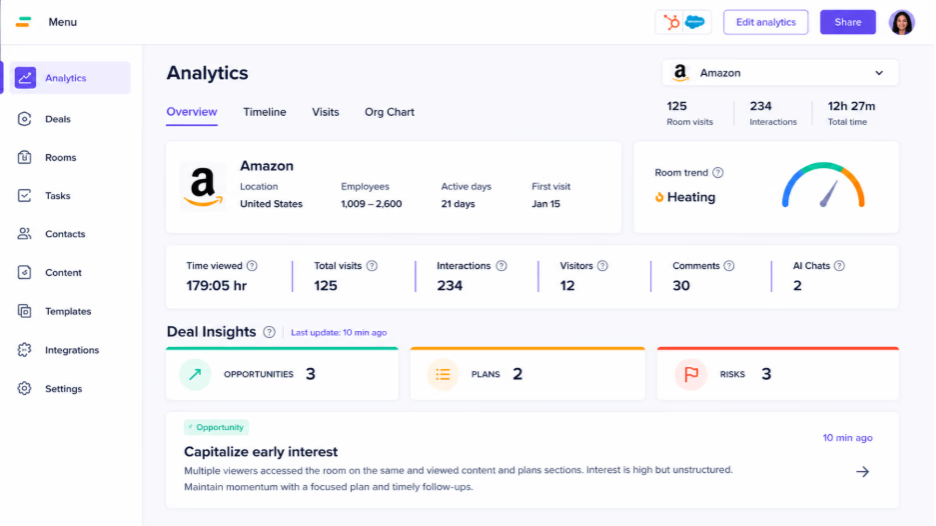
Aligned leans into collaboration rather than static content delivery. Its AI agents can generate proposals and business cases, suggest next steps, and even help guide buyers directly inside the room, with granular commenting and permissioning layered on top.
Key features:
- AI-generated content and next-best-action suggestions
- Section-level and user-level engagement analytics
- Deep two-way Salesforce and HubSpot sync
- Automated room creation
- Granular commenting and permission controls
Best fit for: Mid-market teams that want an AI co-pilot embedded in the deal itself, prioritizing a polished pre-sale experience over post-sale continuity.
Pricing: Free Starter tier, Basic at $35/seat/month, Pro at $60/seat/month, and custom Enterprise pricing.
3. Dock: Best for a Clean Handoff from Sales to Customer Success
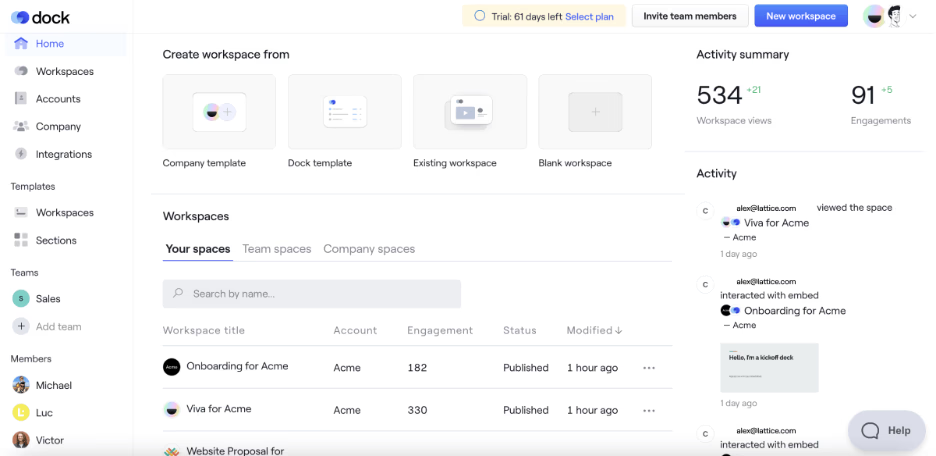
Dock’s whole pitch is continuity. Instead of treating the sale and the onboarding as two separate systems, it keeps everything in one workspace with native Salesforce and HubSpot integrations built in.
Key features:
- Single workspace spanning the entire deal lifecycle
- Configurable end-to-end workflows
- Proposal and video support
- Native Salesforce and HubSpot integrations
- Expanding AI capabilities (currently in beta)
Best fit for: B2B SaaS teams where onboarding is a defined process worth measuring, not an afterthought.
Worth knowing: Its CPQ and commerce capabilities are lighter than some competitors, and AI features are still in beta.
Pricing: Free tier, Standard at $350/month, Premium at $1,000/month (billed annually), and custom Enterprise plans. Note this is flat platform pricing, not per seat.
4. GetAccept: Best for Proposal-Heavy, CRM-Dependent Sales Teams
If your priority is getting proposals out the door and signed quickly, GetAccept is built for exactly that. It pairs no-code deal room templates with e-signatures, in-document chat, and video messaging, while supporting more CRMs than most competitors, including Microsoft Dynamics and Pipedrive alongside Salesforce and HubSpot.
Key features:
- No-code deal room templates
- Native e-signatures
- Live in-document chat and video messaging
- AI-personalized content and business cases
- Native integrations with Salesforce, HubSpot, Microsoft Dynamics, and Pipedrive
Best fit for: Larger sales teams with high proposal volume operating across more than one CRM.
Pricing: GetAccept offers three plans: eSign ($25/user/month), Professional ($49/user/month, minimum 5 users), and Enterprise (custom pricing). Higher tiers unlock AI-powered Digital Sales Rooms, CRM and sales intelligence integrations, mutual action plans, advanced stakeholder engagement, and enterprise features.
5. Trumpet: Best for Brand-Forward, Highly Visual Buyer Experiences
Trumpet’s rooms, called Pods, are built for teams that care about presentation. Navigation, headers, fonts, and content blocks are all customizable, and its AI layer tracks engagement down to the individual stakeholder, flagging deals that are losing momentum before a rep would otherwise notice.
Key features:
- Fully customizable Pods, including navigation and fonts
- Stakeholder-level deal health scoring
- AI-generated executive summaries
- AI-generated business cases
- Two-way Salesforce and HubSpot integration
Best fit for: Design-conscious, presentation-driven enterprise sales teams that want granular visibility into who’s engaged.
Worth knowing: No native digital commerce integration, and CPQ is only available through the API.
Pricing: Free tier with 10 rooms, Pro at $45/user/month, Scale at $100/user/month, and Elite at $160/user/month.
6. Flowla: Best for Teams That Want AI Handling the Busywork
Flowla structures every deal as a step-by-step journey and lets its AutoPilot feature build trigger-based workflows that take care of routine follow-ups and content delivery on their own. Mutual action plans can render as task lists, boards, or Gantt charts depending on what a team prefers.
Key features:
- Step-by-step deal journeys
- Trigger-based AutoPilot workflows
- Customizable AI agents with human approval
- Flexible mutual action plans in list, board, or Gantt views
- Fast, low-admin setup
Best fit for: Smaller, growing teams that want a lean, automated setup without a lot of administrative overhead.
Worth knowing: It’s proven out best at smaller scale so far, and e-signature support isn’t confirmed.
Pricing: Free Starter tier, Pro at $49/seat/month, Team at $79/seat/month, and custom Enterprise pricing.
7. Accord: Best for Standardizing a Repeatable GTM Motion
Accord is less about the buyer experience and more about operationalizing how your whole team sells. Playbooks can be tailored by segment or vertical, and AI is woven into account research, seller scoring, and executive summaries, giving leadership visibility into how closely reps are following the process.
Key features:
- Standardized, segment-specific playbooks
- AI-powered account and stakeholder insights
- Seller behavior scoring against sales methodology
- Integrated mutual action plans and stakeholder mapping
- Bidirectional CRM synchronization
Best fit for: Sales organizations with a defined methodology that want consistent execution across reps, not just a nicer-looking deal room.
Pricing: Flat annual fee for larger customers, per-user monthly pricing for smaller teams.
Quick Comparison: Top 7 Digital Sales Room Platforms
| Platform | AI Capability | CRM Sync | Buyer-Editable Action Plans | Onboarding Continuity | Starting Price |
| Projetly | Advanced AI agent | Bi-directional | Yes | Yes, automated handoff | Custom pricing |
| Aligned | AI agent + content generation | Bi-directional | Yes | No | Free, then $35/seat/mo |
| Dock | AI agent (beta) | Yes | Yes | Yes, single workspace | Free, then $350/mo flat |
| GetAccept | AI content + transcripts | Yes | Yes | No | $25/user/mo |
| Trumpet | Deal-health scoring AI | Yes | Yes | No | Free, then $45/user/mo |
| Flowla | Custom AI agents | Yes | Yes | No | Free, then $49/seat/mo |
| Accord | AI research + scoring | Bi-directional | Yes | Onboarding playbooks | Per-user, custom for larger teams |
Which One Actually Fits Your Sales Motion?
A quick way to narrow it down:
- Complex, multi-stakeholder enterprise deals with onboarding continuity: Projetly or Dock
- AI-assisted, collaborative buying experience with guided deal execution: Aligned
- High-volume proposal management across multiple CRM platforms: GetAccept
- Highly branded, presentation-first digital sales experiences: Trumpet
- Lean sales teams that need automation with minimal administration: Flowla
- Standardizing sales execution with repeatable playbooks and workflows: Accord
The common thread across all seven is the same: a digital sales room only pays off if your buyers actually open it, and your reps actually use it. Pick the platform that fits how your team already sells, not the one with the longest feature list.
Frequently Asked Questions
- What’s the difference between a digital sales room and a regular proposal tool?
A proposal tool sends one document and stops there. A digital sales room stays live for the whole deal, holding proposals, pricing, case studies, recordings, and e-signatures in one trackable workspace, and in some platforms, it keeps working after the deal closes too.
- Do these platforms work with the CRM we already use?
Support for Salesforce and HubSpot is close to standard across this list. Coverage for other CRMs varies more, so if you run something like Microsoft Dynamics or Pipedrive, check the specific platform’s integration depth before committing.
- Which of these seven is the easiest to set up for a small team?
Flowla and Aligned are both built for fast deployment with minimal admin overhead, making them a natural starting point for smaller or leaner sales teams that want something running quickly.
- Are mutual action plans actually editable by buyers, or just visible to them?
It depends on the platform. Projetly, Aligned, Dock, and Flowla all support buyer-side editing and task ownership, not just view access. Others in this space keep the plan seller-managed with the buyer able to see it but not change it, so it’s worth confirming directly if two-way editing matters to your process.
- What size deal justifies bringing in a digital sales room?
These platforms tend to pay off most on multi-stakeholder deals with cycles longer than about 30 days, generally in the $20K+ ACV range. For single-call, low-ticket, or highly transactional sales, the setup effort usually outweighs the benefit.